The Ethereum validator queue continues to grow, with approximately 1.5 million ETH waiting to participate in the staking system, while 2.45 million ETH are in the withdrawal queue of off-chain validators.
The queuing mechanism is designed as a rate-limiting measure to maintain network stability. Ethereum processes activation requests and validator withdrawals at a fixed rate each epoch of approximately 6.4 minutes, helping to prevent sudden shocks that could affect the security model when too many validators join or withdraw at the same time. The current wait time for staking participation can extend to several days depending on the backlog of requests, while the withdrawal process also experiences similar delays as the network processes each request in an orderly manner.
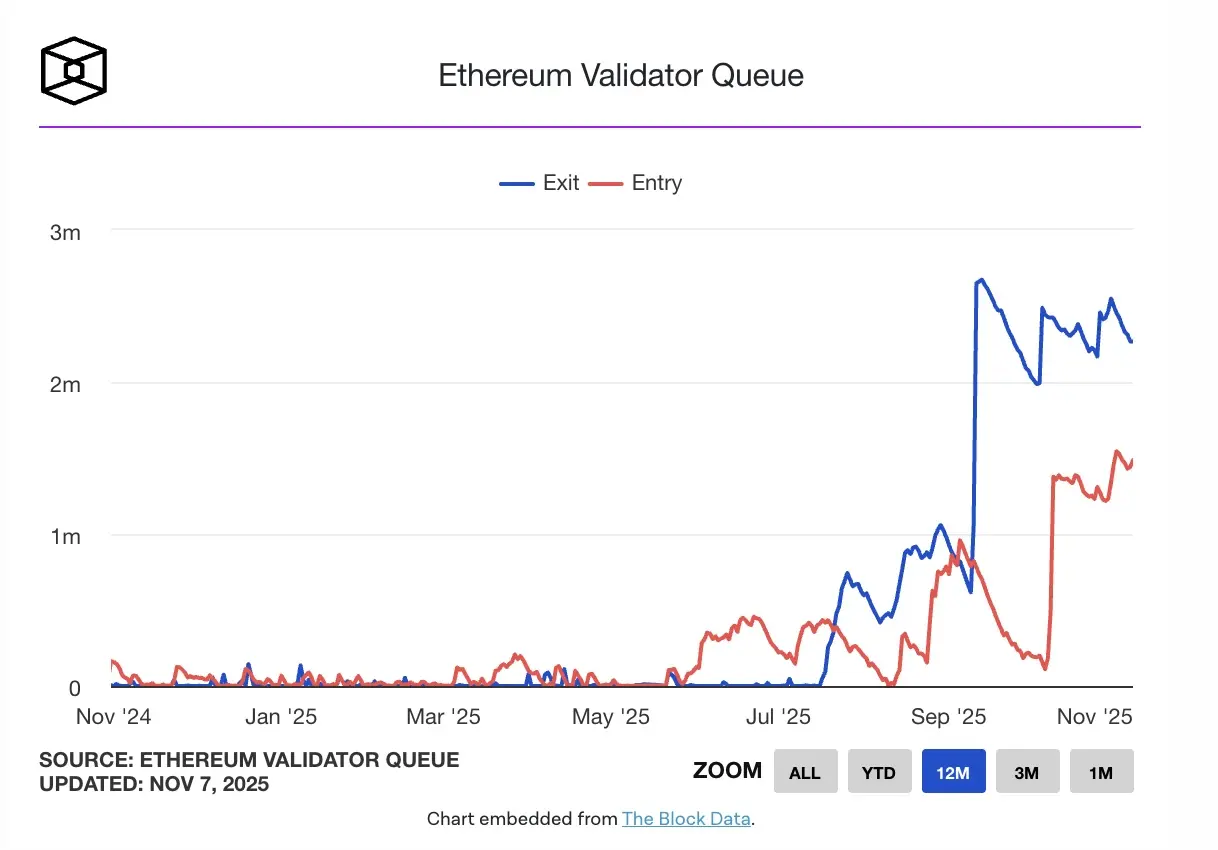 The ETH staking waiting list continues to grow | Source: The BlockDirect staking on the (native staking) demonstrates a deliberate choice compared to liquidity staking products (liquid staking derivatives), even though protocols like Lido and Rocket Pool offer more flexibility with tokens such as stETH and rETH — allowing investors to earn staking rewards while using capital for other purposes.
However, direct staking is attractive to validators who want full control over their infrastructure, avoiding risks from the smart contracts of liquidity staking protocols and eliminating reliance on intermediaries. The minimum requirement of 32 ETH along with the necessary technical know-how creates a certain barrier, but at the same time ensures that only serious, long-term participants are motivated to maintain the network. Locking capital in direct staking also means accepting slow withdrawal times, the risk of being penalized (slashing) when the validator operates incorrectly, and technical risks from the staking mechanism itself.
These factors filter out participants with a long-term vision and strong belief in the future of Ethereum.
Currently, Ethereum has established itself as the main payment infrastructure for large-scale economic activities, with the majority of stablecoin volume being traded directly on the network and many leading DeFi protocols like Aave conducting most lending activities on the mainnet.
As financial institutions become increasingly confident in Ethereum, many investors are willing to commit capital for the long term to both ensure network security and reap returns. The growing waiting list to participate in staking indicates a strong belief that Ethereum will continue to maintain its position as the leading smart contract platform, making the opportunity cost of locking up capital acceptable for investors seeking profits.
Thạch Sanh
Disclaimer: The information on this page may come from third parties and does not represent the views or opinions of Gate. The content displayed on this page is for reference only and does not constitute any financial, investment, or legal advice. Gate does not guarantee the accuracy or completeness of the information and shall not be liable for any losses arising from the use of this information. Virtual asset investments carry high risks and are subject to significant price volatility. You may lose all of your invested principal. Please fully understand the relevant risks and make prudent decisions based on your own financial situation and risk tolerance. For details, please refer to
Disclaimer.
Related Articles
ETH 15-minute increase of 0.83%: Whales' capital inflow and DeFi lending demand resonate to drive the price
Between 13:30 and 13:45 (UTC) on March 11, 2026, ETH experienced a short-term fluctuation. The candlestick data shows a return of +0.83%, with a price range of 2046.07 to 2082.31 USDT, and an amplitude of 1.77%. Market activity increased during this period, with trading volume significantly higher than the previous cycle, and volatility exceeding the intraday average, attracting widespread market attention.
The main drivers of this fluctuation were the rapid inflow of large on-chain funds and active institutional accounts. Between 13:32 and 13:43,
GateNews26m ago
A certain address deposited 28,970 ETH into a CEX, with a value of approximately 59.05 million US dollars.
Gate News Report, March 11 — According to Lookonchain monitoring, a Gnosis Safe Proxy multi-signature wallet address 0x23A5 just deposited 28,970 ETH into a CEX, worth approximately $59.05 million.
GateNews40m ago
USDC and CCTP officially launch on Ethereum L2 network Morph
USDC and the cross-chain transfer protocol CCTP are now live on the Ethereum L2 network Morph, supporting payments, remittances, and DeFi transactions. CCTP enables cross-chain transfer of USDC between Morph and other blockchains. The first batch of integrated partners includes a CEX, Bulba, and Stargate.
GateNews2h ago
Ethereum on-chain activity explodes: daily active addresses approach 2 million, smart contract calls exceed 40 million for a new high, but ETH drops 30% and transaction fees lose to Tron
CryptoQuant March Report indicates that Ethereum on-chain activity has reached a record high, but ETH prices have fallen 30% over the past six months, and transaction fee revenue has lagged behind other public chains. The report analyzes that the factors driving ETH prices have shifted from on-chain usage to capital flows, prompting the market to reconsider Ethereum's value proposition.
動區BlockTempo2h ago
The U.S. Department of Justice seizes $3.4 million USDT in connection with Ethereum investment fraud and money laundering
The U.S. Attorney's Office in Massachusetts has filed a civil forfeiture lawsuit seeking to recover $3.4 million in USDT related to cryptocurrency fraud and money laundering schemes. Victims were misled into investing in a fake Ethereum project, with their funds ultimately flowing to unidentified controllers.
GateNews3h ago


