


Polymarket pushes 5-minute Bitcoin price prediction! Traders bet on short-term speculation

Forecasting platform Polymarket has recently launched a new feature allowing users to place bets on cryptocurrency price movements every five minutes. This event indicates a growing demand among traders and investors for real-time crypto sentiment data. The target users for this feature are intraday traders and crypto enthusiasts seeking a fast-paced trading experience, especially as Bitcoin’s recent price declines have become increasingly volatile, intensifying short-term fluctuations.
The Ultimate Short-Term Focus of 5-Minute Predictions
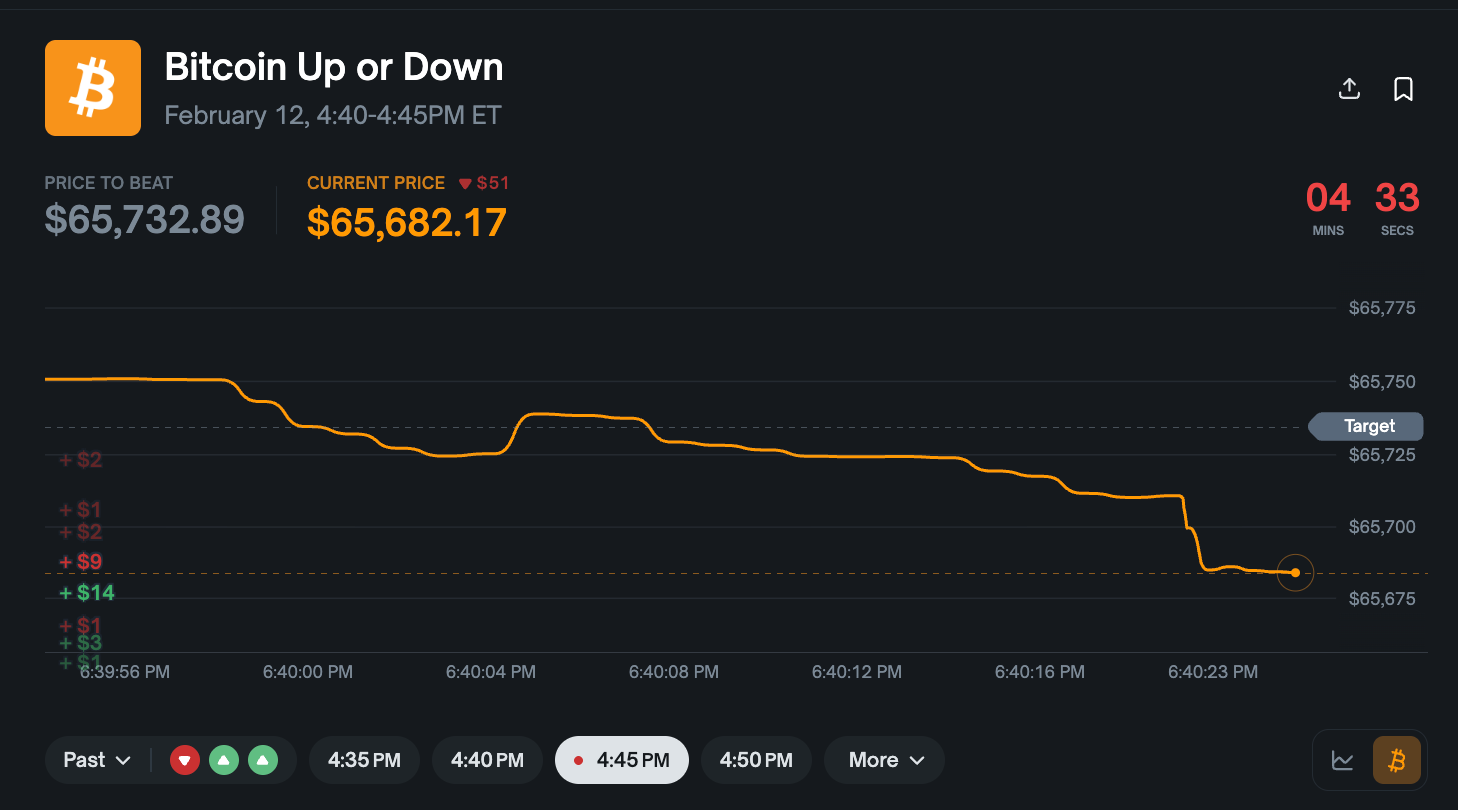
(Source: Polymarket)
Polymarket’s introduction of the five-minute betting feature pushes prediction markets to an extreme level of short-termism. Currently, the new market is limited to Bitcoin, but it is expected to support other major cryptocurrencies soon. Prices will dynamically update based on market sentiment and real-time price reactions. All trades will be executed on-chain to ensure transparency and security. The target users are intraday traders and crypto enthusiasts seeking rapid trading experiences.
A 5-minute prediction cycle is extremely rare in financial markets. Traditional futures or options typically span weeks, months, or even years. Even high-frequency trading strategies are executed on seconds or milliseconds, but there are no standardized contracts for “price rise or fall after 5 minutes.” Polymarket has created such a product, essentially “gambling” on crypto trading. Bitcoin’s price fluctuations within five minutes are almost entirely random; fundamental and technical analysis are nearly useless at this time scale, making it more akin to rolling dice.
As Bitcoin’s recent price declines have increased volatility, short-term fluctuations have become more pronounced. The plan is to base this on existing contracts with varying durations, from 15 minutes, 1 hour, to 4 hours. Meanwhile, the usage of prediction markets is growing exponentially, with individual polls trading hundreds of millions of dollars. The gradual shortening from 4 hours to 1 hour, 15 minutes, and finally 5 minutes demonstrates Polymarket’s ongoing exploration of market acceptance for ultra-short-term betting.
Evolution of Polymarket’s Time Cycles
Early: Political elections, long-term events (months to years)
Expansion: Sports matches, entertainment events (days to weeks)
Radical phase: Crypto prices 4 hours → 1 hour → 15 minutes
Current: 5-minute Bitcoin predictions, extreme short-term focus
The motivation for this shortening is clear: shorter cycles mean faster settlements, higher trading frequency, and increased fee revenue. For Polymarket, a political election market lasting months may generate large trading volume but only settle once. In contrast, a 5-minute Bitcoin market can settle 288 times a day; if each settlement involves trading, fee income can grow exponentially.
Speculative Frenzy with Tens of Millions in February Bitcoin Trading Volume
Among numerous polls offered by prediction platforms like Polymarket and Kalshi, a significant portion involves crypto betting. More specifically, many of these contracts focus on predicting the future prices of major digital assets. In recent months, interest in such bets has surged. Just in February, Bitcoin’s price attracted tens of millions of dollars in trading volume, with active trading also seen in contracts related to Ethereum, XRP, and Solana.
Tens of millions in monthly trading volume is substantial for a niche market. While far below the daily trading volume of the broader crypto spot and derivatives markets (hundreds of billions of dollars), this figure is remarkable considering it’s based on “price predictions” rather than actual asset trading. Participants likely include: professional traders hedging spot or futures positions, pure speculators, and quantitative teams testing strategies.
As the overall crypto market struggles to regain growth momentum, these predictions are gaining attention. In this environment, market volatility itself seems to stimulate trading activity, with traders exploiting market weakness for short-term speculation. When “buy-and-hold” strategies continue to lose in a bear market, “short-term predictions” offer an alternative way to participate. Even if Bitcoin’s price stagnates or declines, as long as there is volatility, prediction markets can generate profits.
This phenomenon also reflects a shift in the mindset of crypto participants—from “long-term believers” to “short-term speculators,” from “technological revolution” to “price gaming.” Such a shift could be detrimental to the long-term development of the industry, as it reinforces the negative perception that “crypto is gambling,” rather than emphasizing “crypto as financial innovation.”
Concerns and Criticisms of Long-Term Crypto Development
While the surge in such polls brings significant trading activity, it also disperses capital and attention away from fundamentals. The narrative of cryptocurrencies no longer focuses on integration or real-world applications but may turn toward probability and crowd positioning. The new five-minute betting feature on Polymarket further amplifies this trend.
If price-based betting continues to attract more capital than long-term allocations, markets may increasingly revolve around price volatility rather than sustainable value creation. This criticism points to a fundamental issue in the industry: when market participants’ primary goal shifts from “supporting technological innovation and financial democratization” to “making quick money from price swings,” the industry’s direction may deviate from its original purpose.
Bitcoin was created as a peer-to-peer electronic cash system; Ethereum’s vision is a decentralized world computer; XRP aims to revolutionize cross-border payments. But when these technologies’ main use cases become “betting on whether prices will rise or fall in 5 minutes,” the significance of technological innovation is severely diminished. Worse, such gambling-like activities could attract regulatory crackdowns, equating the entire crypto industry with illegal betting.
For Polymarket, the 5-minute markets are a commercial success—boosting trading frequency and revenue—but may be a strategic mistake, increasing regulatory risks and societal negative perceptions. As controversies like the Nancy Guthrie kidnapping case, Israeli military secrets leaks, and now the 5-minute betting frenzy accumulate, Polymarket may face the “shotgun effect,” becoming a target for regulators seeking to make an example.
For crypto investors, participating in these 5-minute predictions is more akin to gambling than investing. Small, entertainment-based participation poses little risk, but heavy involvement with large sums could lead to losses due to randomness. A more rational approach is to focus on long-term fundamentals and engage with genuinely valuable crypto projects rather than wasting time and money on short-term price speculation.
Related Articles
Analysis: Currently, the crypto market lacks incremental funds, and it is premature to talk about a bull market or a major rebound.
Zcash Price Prediction: Major Holders Sell 38% in 7 Days, ZEC Technical Pattern Indicates 66% Downside Potential
$2.5 billion in options are expiring simultaneously, Bitcoin fluctuates around $68,000, and $74,000 becomes the dividing line between bullish and bearish sentiment.
Matrixport: Price breaks below key level, market has entered confirmed bear market stage