


Cardano integrates LayerZero with massive assets! Daily trading only 2 million raises liquidity concerns
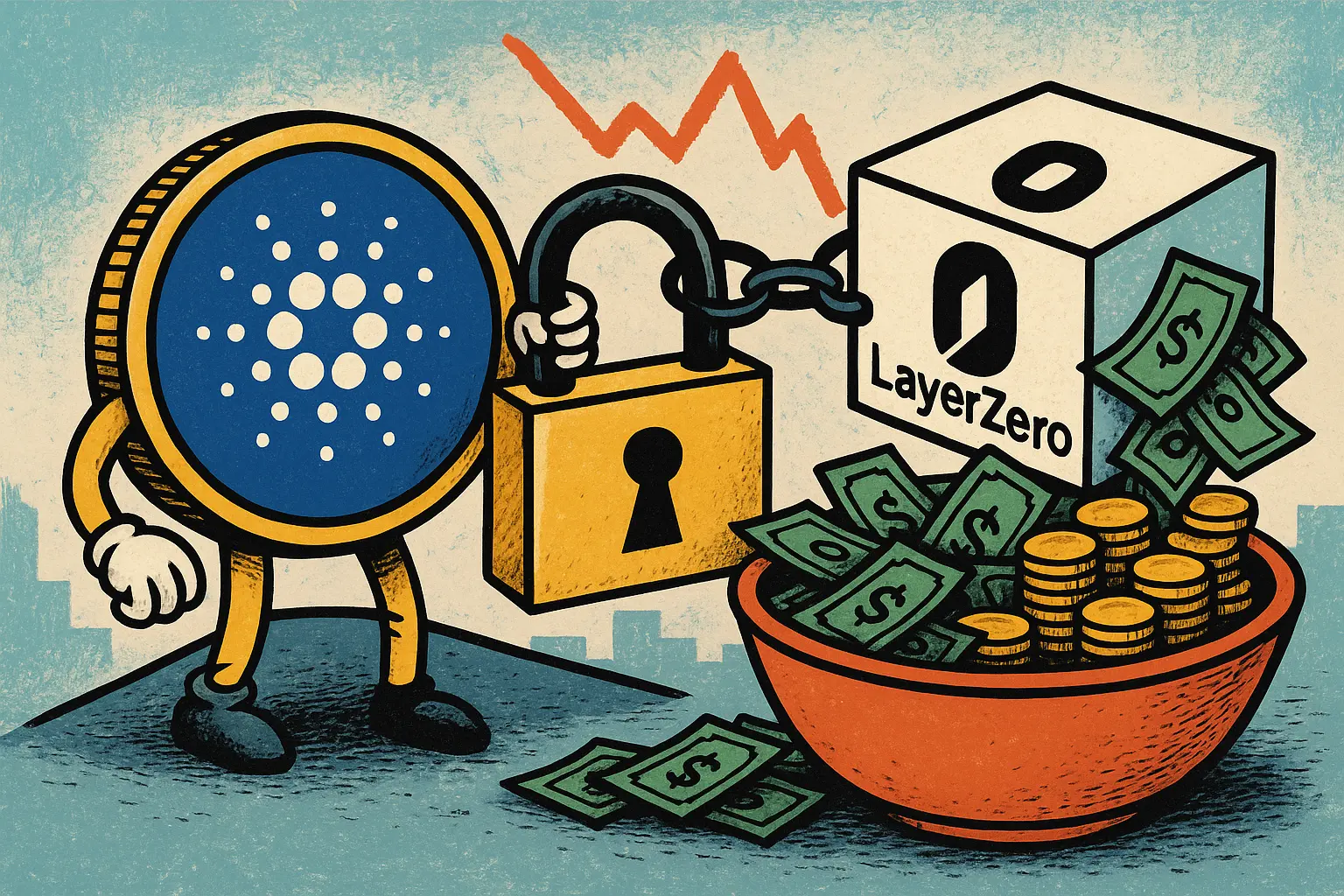
Cardano’s integration with LayerZero, a cross-chain messaging system, unlocks access to over 160 blockchains and more than 400 types of OFT tokens (with a total market cap exceeding $80 billion). LayerZero has facilitated over $200 billion in cross-chain transactions. However, data shows that Cardano’s total value locked (TVL) is only about $125 million, with stablecoin market cap around $37 million.
$80 Billion vs. $125 Million: The Liquidity Gap in Cardano
Cardano is actively expanding the types of tokens that can operate on its network and aims to increase its DeFi ecosystem’s capacity over the next 12 to 18 months. On February 12, the blockchain led by Charles Hoskinson announced an integration with the widely used cross-chain messaging system LayerZero. This marks the largest interoperability unlock in Cardano’s history, as LayerZero connects over 160 blockchains and has enabled more than $200 billion in cross-chain transactions.
LayerZero’s core value lies in its chain-agnostic messaging layer. This means applications can send and receive messages between endpoints without regard to the underlying blockchain’s execution model. For Cardano, this allows direct access to major blockchain ecosystems—including Ethereum, Solana, Base, Arbitrum, BNB Chain, Sui, and over 140 other chains—without changing its underlying architecture.
This architectural difference has long been a barrier to practical application. Cardano is built on an extended UTXO model, similar to Bitcoin’s architecture, designed for determinism, predictability, and security. Most of the crypto economy, including Ethereum, Solana, and Base, operates on an account-based model. Since many cross-chain tools are primarily designed for account-based systems, Cardano often faces additional hurdles in accessing cross-chain liquidity.
LayerZero’s integration aims to bridge this gap. It does not require Cardano to adopt an account-based model but achieves interoperability through messaging endpoints. If Cardano becomes a supported endpoint, it will be part of the same connection layer used by many projects to coordinate cross-chain operations. The most immediate impact on the asset layer is the OFT standard. OFT is designed to exist natively across multiple blockchains, maintaining a single supply through burn-and-mint mechanisms. Tokens are burned on one chain and minted on another, coordinated via the messaging layer.
Because LayerZero’s token catalog is extensive, its integration into the Cardano ecosystem is significant. Currently, over 400 tokens adopt the OFT standard, with a combined market cap exceeding $80 billion. While Cardano will not automatically inherit liquidity, it provides a technical pathway for these existing assets to expand onto Cardano.
$80 Billion vs. $125 Million: The Harsh Reality
Potential accessible assets: $80 billion (LayerZero OFT token market cap)
Current Cardano TVL: $125 million (only a fraction of potential assets)
Stablecoin market cap: $37 million (severely lacking)
Daily DEX trading volume: $2 million (very low activity)
This vast gap highlights Cardano’s core challenge: technical interoperability does not automatically translate into real-world application. Announcing access to $80 billion in assets sounds impressive, but holders and issuers must actively choose to deploy assets on Cardano. This decision depends on whether Cardano can offer sufficient user base, liquidity, and use cases.
Technical Pathways vs. Actual Adoption: Cardano’s Real Test
For years, Cardano has focused on formal methods and a security-first development philosophy. Its practical downside has been weaker ties to the broader multi-chain economy, limiting its competitiveness in liquidity and application activity. Timing is crucial: since Cardano’s DeFi starting point is relatively low, even small changes can have outsized effects.
Data from DefiLlama shows Cardano’s TVL at about $125 million, stablecoin market cap around $37 million, and 24-hour DEX volume roughly $2 million. Compared to major platforms, these figures are tiny, making interoperability a potential catalyst. For comparison, Ethereum’s TVL exceeds $40 billion, Solana over $10 billion, and even emerging chains like Base hold around $2 billion. Cardano’s $125 million is only about 0.3% of Ethereum’s.
This underscores LayerZero’s value for Cardano. If Cardano becomes an endpoint within a system covering over 160 blockchains and supports deployment of over 400 OFT tokens (with a combined market cap over $80 billion), it need not dominate global liquidity—its on-chain profile could change significantly.
However, this mechanism is not automatic. Cardano must deploy and actively use these integrations. It needs stablecoins to remain on the platform long enough to support trading and lending. It requires tokenized assets as collateral, not just fleeting capital flows. It needs applications that attract users who might otherwise stay on other networks.
Supporters of the integration believe it will make assets that are difficult to use on Cardano—such as stablecoins, Bitcoin-related liquidity, tokenized real-world assets, and DeFi modules—more accessible. This includes lending assets, governance tokens, and liquidity staking derivatives operating across multiple networks via LayerZero.
For developers, this integration marks a shift from building for a single network to building for a decentralized layer. Developers can use LayerZero’s OApp standard to create cross-chain applications, a framework also used by projects like Ethena, PayPal, BitGo, Stargate, and many others. It also enables teams to develop on Cardano while reaching users and liquidity on connected chains.
A Critical 12-18 Month Validation Period
The coming quarters will reveal whether OFT token issuers will truly expand to Cardano, whether stablecoin holdings will grow beyond the current $37 million, and whether Cardano’s DeFi activity will increase from its current $125 million TVL and roughly $2 million daily DEX volume. If these metrics improve in tandem, LayerZero’s integration will be more than just a pipeline—it will be a form of distribution. If not, Cardano will still expand its connectivity but will reinforce a familiar lesson in crypto: interoperability is increasingly important, but demand must be cultivated through effort.
The most recent milestone is implementation. This involves deploying LayerZero Endpoint smart contracts on Cardano, which will then support OFT-compatible tokens. Cardano supporters also emphasize ongoing investments in critical infrastructure, including stablecoins, cross-chain bridges, custody solutions, and institutional tools. Their argument is that LayerZero is just part of a broader effort to make Cardano a place where assets can flow in and stay. This is the core test: interoperability can make assets technically accessible, but it does not automatically ensure stickiness.
From an investment perspective, the short-term impact of the LayerZero integration may boost ADA’s price as a significant technical milestone. However, long-term value depends on actual adoption. Investors should closely monitor data over the next 12-18 months: can stablecoin market cap grow from $37 million to over $100 million? Can TVL increase from $125 million to over $500 million? Can daily trading volume rise from $2 million to over $10 million? Only if these indicators improve substantially will LayerZero’s integration truly change Cardano’s trajectory.
For OFT token issuers, deployment to Cardano depends on cost-benefit analysis. Deployment involves development resources, auditing costs, and liquidity incentives. If Cardano’s user base and trading volume remain too small, these costs may not be justified. This could lead to a “chicken-and-egg” dilemma: lack of assets deters users, and lack of users deters asset deployment. Breaking this cycle requires proactive efforts from the Cardano ecosystem—such as liquidity incentives, gas subsidies, or strategic partnerships.
The 12-18 month window is critical for validation. If DeFi metrics do not significantly improve within this period, the market may conclude that LayerZero’s integration failed to address fundamental issues, and Cardano might never break through in DeFi. Such a judgment would have long-term negative implications for ADA’s price. Conversely, if data shows meaningful growth, Cardano could be reevaluated as an undervalued asset.
Related Articles
Shiba Inu Price at Risk? Key Levels Traders Should Watch
Year of the Horse meme coin Chinese memes explode! I'm riding the horse, dark horse, crying, success at once, who is the Golden Dog?
Greeks.live: BTC and ETH options worth nearly $2.9 billion settle today, with put options dominating
Midnight (NIGHT) recovers as Charles Hoskinson announces the mainnet launch roadmap in March
Analysis: Currently, the crypto market lacks incremental funds, and it is premature to talk about a bull market or a major rebound.