


Massive $50.5 billion payout before Chinese Lunar New Year! The largest dividend wave in history impacts liquidity
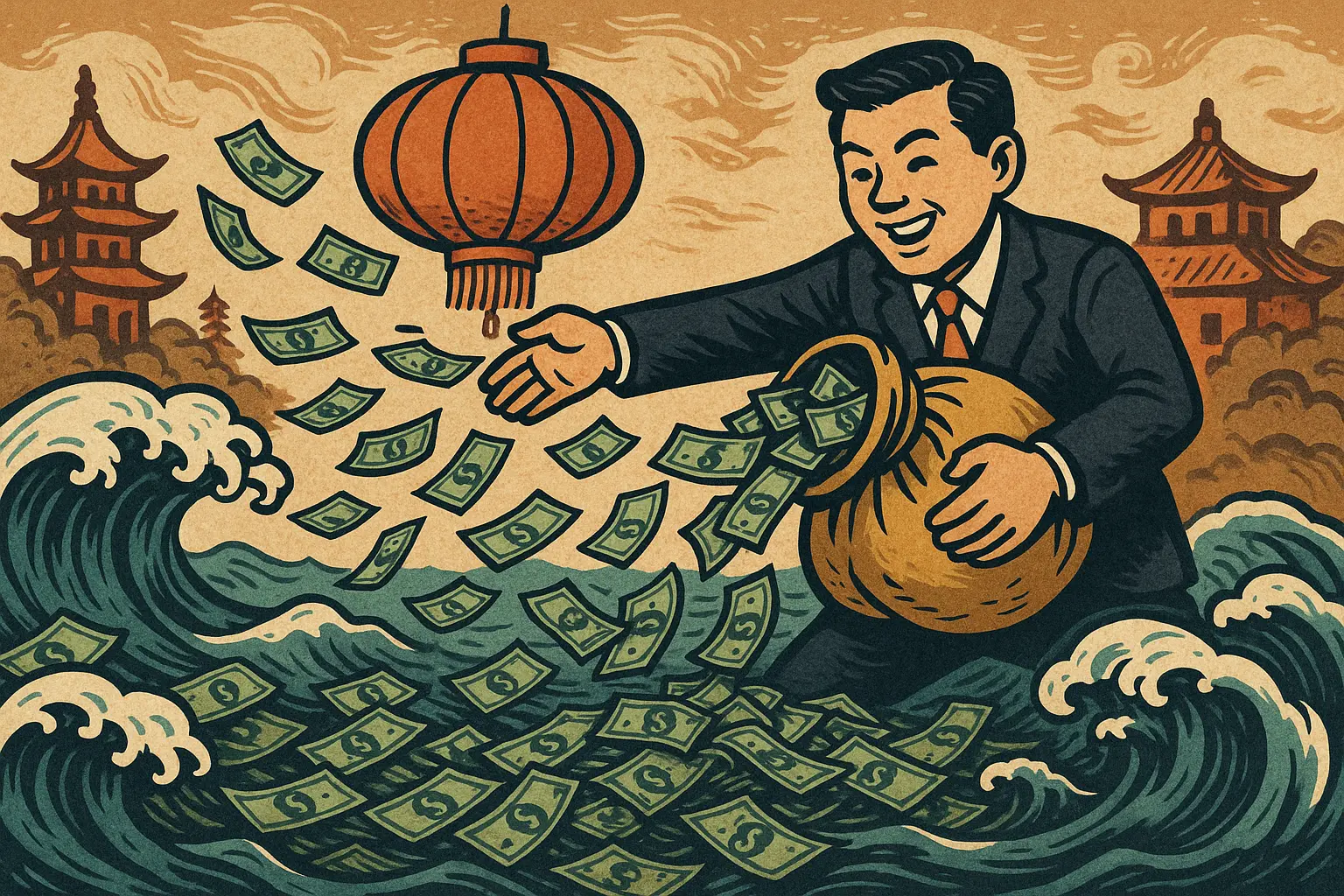
Chinese publicly traded companies distributed a historic dividend payout ahead of the Lunar New Year, totaling 348.8 billion yuan RMB (approximately 50.5 billion USD), setting a new company record. Compared to previous years, this dividend distribution increased by over 20%. The timing is just before China’s peak consumption season, traditionally characterized by excess liquidity that leads investors to chase yields, potentially shifting funds into other investments. Historical data shows that similar liquidity events are often accompanied by increased Bitcoin trading volume and rising risk appetite.
$50.5 Billion Dividend Wave: Results of Regulatory Pressure
Chinese listed companies have paid out a record $50.5 billion in dividends ahead of the Lunar New Year. The total dividends reached 3.488 trillion yuan RMB, hitting a new company high. Compared to previous years, this payout increased by more than 20%, an impressive growth. The timing is crucial—these funds are released just before China’s consumption peak, significantly boosting liquidity at both household and market levels.
Regulatory influence is also a key behind the scenes factor. The China Securities Regulatory Commission (CSRC) has been actively pressuring listed companies to improve shareholder returns. Specifically, the CSRC aims to strengthen capital discipline and enhance stock market quality. Dividend stability has become an important benchmark. This has compelled companies to increase dividends before the holiday. Such regulation-driven dividend growth is rare in the Chinese market.
Traditionally, Chinese companies have had much lower dividend payout ratios than their Western counterparts. Many Chinese firms prefer to retain earnings for reinvestment or debt repayment rather than return capital to shareholders. This culture stems from China’s rapid economic growth period, during which companies needed substantial capital for expansion. However, as economic growth slows, the CSRC believes increasing dividend payout ratios can make the stock market more attractive and draw long-term investors.
The scale of $50.5 billion is also significant globally. For comparison, U.S. S&P 500 companies pay approximately $150 billion in dividends each quarter. A single Chinese payout of $50.5 billion is about one-third of the U.S. quarterly dividend total. Considering China’s total market capitalization is only about 20-30% of the U.S., this dividend scale represents a very high relative proportion.
From a corporate perspective, being able to distribute such large dividends indicates strong profitability. Notably, these dividends are not insignificant—they reflect healthy earnings, especially in technology, manufacturing, and export-oriented industries. Despite macroeconomic challenges, most companies maintain stable cash flows. This stability boosts management confidence to distribute dividends, also signaling confidence in China’s economic recovery.
Three Main Drivers of the $50.5 Billion Dividend
Regulatory Pressure: CSRC’s push for higher dividend payout ratios to improve shareholder returns
Strong Corporate Earnings: Technology, manufacturing, and export sectors with stable cash flows supporting large payouts
Timing of Lunar New Year: Aligning with traditional consumption peak to release liquidity and stimulate the economy
The timing of dividend payments before the Lunar New Year carries deep cultural and economic significance. The holiday is China’s most important traditional festival and a consumption peak. Household spending during this period includes travel, shopping, gifting, dining, etc., totaling trillions of RMB. Receiving dividends before the holiday provides shareholders with extra spending capital, helping to stimulate domestic demand.
From a policy perspective, dividend distribution aligns closely with China’s government’s consumption stimulus measures. Currently, China faces challenges such as insufficient domestic demand, a sluggish real estate market, and uncertain exports. The government is trying to boost consumption through various means, including issuing consumption vouchers, lowering interest rates, and promoting corporate dividends. After the $50.5 billion inflow into shareholders’ pockets, some of these funds are likely to be converted into consumption, creating a multiplier effect on the economy.
Liquidity Injection During Lunar New Year: Consumption, Investment, and Asset Rotation
Lunar New Year is traditionally a period for stimulating consumption and rebalancing assets. Newly available funds are likely to be used for travel, spending, and investment. However, this year’s situation is unique—hundreds of billions of dollars flowing into the market could significantly impact asset prices. As a result, the A-share market may experience temporary stability or capital inflows. This influx is especially timely given recent weak performance in A-shares.
Regarding capital flow, the $50.5 billion dividend will be distributed among hundreds of millions of shareholders, including retail investors, institutional investors, state-owned enterprises, and sovereign wealth funds. Different types of shareholders will use the funds differently. Retail investors may spend or reinvest dividends, institutions might reallocate to other asset classes, and state entities could use funds for policy-driven investments or social spending.
For retail investors holding Chinese stocks, receiving dividends before the Lunar New Year is an important cash flow boost. Many households’ year-end bonuses and dividend income are concentrated at this time, creating a short-term “wealth effect.” This effect can boost consumer confidence and drive spending during the Spring Festival. From a macro perspective, this dividend-driven consumption growth is expected to be reflected in first-quarter GDP data.
For institutional investors, dividend receipt triggers critical asset allocation decisions. They may reinvest in stocks (if optimistic about the market), shift into bonds (for stable returns), or diversify into alternative assets such as real estate, commodities, or cryptocurrencies. This asset rotation will influence various asset prices over the coming weeks.
From the perspective of the A-share market, the dividend payout may lead to a “dividend reinvestment” effect, with some long-term investors using dividends to buy more stocks, providing market support. Conversely, if investors are pessimistic about the market outlook, they might withdraw dividends and shift into other assets, weakening the positive impact of dividends.
In the bond market, conservative investors might choose to buy government or corporate bonds when dividends are received. China’s current government bond yields are around 2-2.5%, offering stable returns. Amid stock market volatility and a sluggish property sector, bonds may become a safe haven. Large inflows of dividends into bonds could push yields lower, benefiting government financing costs.
Excess Liquidity and Potential Crypto Market Linkages
For cryptocurrency investors, this dividend wave’s significance extends beyond surface-level analysis. Excess liquidity often leads investors to chase yields. When traditional markets face uncertainty, capital tends to flow into alternative investments, including cryptocurrencies. Historically, such liquidity events have been associated with increased Bitcoin trading volume and rising risk appetite.
While dividends themselves do not directly trigger a bull market, they often act as catalysts. Dividends can boost market sentiment, relax financial conditions, and alleviate short-term downward pressures. Coupled with expectations of global easing policies, this development adds new variables to liquidity dynamics. In short, capital is flowing—markets are responding accordingly.
From China’s crypto market perspective, although mainland China bans cryptocurrency trading, many Chinese investors participate via offshore exchanges and OTC channels. After dividends are credited, some risk-tolerant investors may allocate funds into crypto assets. While difficult to quantify precisely, historical seasonal patterns show increased crypto trading activity around the Spring Festival period in China.
However, caution is warranted in interpreting “dividends flowing into crypto.” Although $50.5 billion is large, it represents only a small fraction of China’s trillions of dollars in financial assets. Even if 1% of dividends flow into crypto, that’s only about $500 million—relatively modest in the global crypto context. Moreover, the current global crypto market is in a correction phase, and Chinese capital inflows may be offset by broader market pressures.
From a macro liquidity standpoint, dividend payouts are an important component of China’s liquidity environment. When companies distribute cash to shareholders, funds move from corporate balance sheets into personal and institutional accounts, activating liquidity from “dormant” to “active.” This activation benefits the entire financial system, lowering funding costs and boosting risk appetite.
In terms of asset allocation strategy, the “golden window” for reallocating dividends typically lasts 2-4 weeks. During this period, trading volumes and price volatility across asset classes tend to increase. For traders, this is a key window to capture short-term opportunities. For long-term investors, observing where funds ultimately flow provides important market sentiment signals.
Historically, the period around the Spring Festival shows relatively stable capital flow patterns. Pre-holiday (January-February), liquidity is abundant, consumption is high, and market sentiment is optimistic. Post-holiday (March), as consumption peaks subside, liquidity normalizes, and markets enter a calmer phase. Understanding this seasonal pattern can help investors better time their allocations.
For global investors, while China’s $50.5 billion dividend payout is an internal event, its influence can ripple through global markets via capital flows, sentiment contagion, and supply chain linkages. Monitoring shifts in Chinese capital flows is valuable for understanding global liquidity trends and asset price movements.
Related Articles
BitMine's book loss is nearly $8 billion, yet BlackRock increased its holdings by 165.6%. Why is BMNR still being supported?
Trading Time: AI Panic Escalates Ahead of CPI, Bitcoin Fluctuates and Bottoms Out, Difficult to Reproduce "Spring Festival Market"
Major Hong Kong Hedge Fund Reportedly Broke Down During BTC Crash - U.Today
ETHZilla Sells Off Ethereum to Launch Jet Engine! $12.2M Transition to RWA Tokenization
Data: 676 BTC transferred from an anonymous address, routed through a relay, and flowed into Cobo.com
Account evaporation of $318 million! Hyperliquid Strategies bets on HYPE and hits a snag