


Cardano aims to launch the USDCx stablecoin to enhance liquidity in February
Cardano Blockchain Ecosystem to Integrate USDCx, an Improved Version of the USDC Stablecoin Issued by Circle, Expected to Launch by the End of February
On February 15, Philip DiSaro, CEO of smart contract development firm Anastasia Labs, officially confirmed that USDCx will be deployed on the Cardano network before the end of this month.
Cardano Aims to Address Stablecoin Shortage with the Launch of USDCx
USDCx is a dollar-pegged stablecoin backed 1:1 by USDC through Circle’s xReserve infrastructure. Circle is known as the issuer of USDC, the second-largest stablecoin by market capitalization.
According to DiSaro, USDCx will function similarly to original USDC for individual users, enabling seamless transactions on decentralized applications (dApps). However, he also noted that USDCx has some minor differences in the conversion mechanism compared to USDC.
“USDCx is essentially identical to USDC for individual users. The only difference lies in the conversion process: USDC can be directly exchanged for USD in a bank account via Circle, but this only applies to Circle’s institutional partners. This does not affect individual users or even professional DeFi investors, as they also cannot perform direct conversions with USDC,” DiSaro explained.
Despite this small difference, DiSaro emphasized that USDCx retains all the features and utilities of USDC within the Cardano ecosystem.
“USDCx is not a less complete version of USDC. It has all the features USDC offers to individual users. You can transfer USDCx to any chain supporting the CCTP protocol with just one transaction—similar to how USDC works. Any transaction payable with USDC can also be done with USDCx,” DiSaro stressed.
A Major Step Forward in Cardano’s Infrastructure Upgrade
Experts see the launch of USDCx as a significant milestone in upgrading Cardano’s infrastructure.
For a long time, the blockchain led by Charles Hoskinson has struggled to attract substantial stablecoin liquidity compared to leading competitors like Ethereum and Solana. According to DeFiLlama, the stablecoin supply on Cardano currently stands below $40 million, a modest figure compared to billions of dollars on rival blockchains.
Previous efforts to improve stablecoin liquidity on Cardano largely fell short, putting the network at a disadvantage in the race for market share in decentralized finance (DeFi). Therefore, the launch of USDCx is expected to address the persistent fragmentation of liquidity and enhance Cardano’s DeFi capabilities.
Expanding Interoperability via LayerZero
In addition to launching USDCx, Cardano is also working to shed its image as an isolated blockchain by integrating with LayerZero—a protocol that enables cross-chain communication.
By leveraging LayerZero, applications on Cardano will be able to interact securely with over 50 other networks, including Ethereum and Solana. This move is seen as a strategic step to expand Cardano’s influence within the global blockchain ecosystem.
Challenges Still Ahead
However, despite these improvement efforts, investors remain cautious. Data from Coinphoton shows that ADA—the native token of the Cardano network—has decreased by over 25% in the past month, reaching a two-year low of $0.24. Currently, the price has slightly recovered to $0.28.
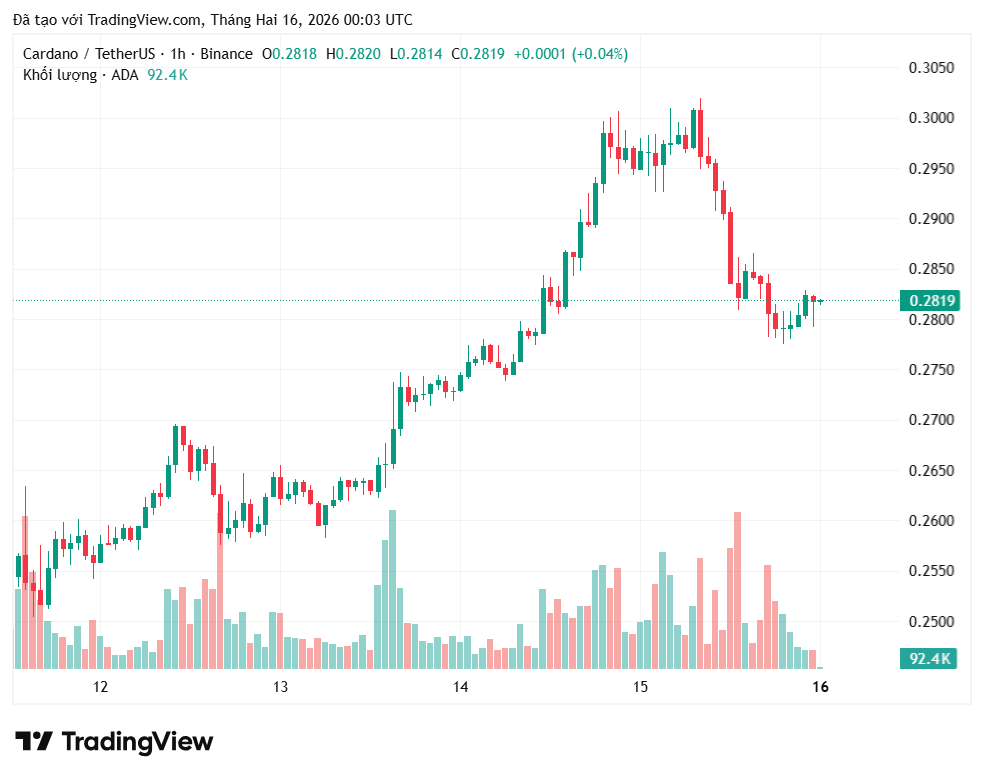
| Source: Coinphoton
This price trend reflects the overall decline in the cryptocurrency market and indicates investor skepticism about Cardano’s ability to capture market share in an increasingly competitive crypto landscape.
Nevertheless, with strategic moves like the launch of USDCx and LayerZero integration, Cardano is striving to affirm its position in the challenging blockchain space.