


Countdown to U.S. Senate Crypto Bill: Probability of CLARITY Act Passing Rises to 69%, Stablecoin Yield Dispute Becomes a Key Variable
February 26 News: The U.S. Senate Democrats recently held a meeting focused on advancing legislation for the cryptocurrency market structure, with key attention on the CLARITY Act and its feasibility for implementation in 2026. The bill aims to clarify the regulatory roles of the U.S. Securities and Exchange Commission (SEC) and the Commodity Futures Trading Commission (CFTC), establishing a clearer compliance framework for digital asset platforms, stablecoin issuers, and the DeFi ecosystem. It is seen as a significant milestone in U.S. crypto regulation policy.
Currently, the White House’s policy coordination deadline of March 1 is approaching. The rules on stablecoin yields have become a major point of contention between the two parties. Democrats favor strengthening investor protection, limiting potential financial risks, and emphasizing anti-money laundering and banking regulation compatibility; Republicans and the crypto industry, on the other hand, support a regulatory environment that encourages technological innovation to maintain U.S. leadership in blockchain and artificial intelligence.
Meanwhile, senior executives from venture capital firm a16z, Marc Andreessen and Chris Dixon, briefed Senate Republicans on policies, highlighting the importance of the U.S. Senate crypto bill in maintaining America’s leadership in crypto asset regulation, AI innovation, and digital financial infrastructure. Collin McCune, head of government affairs at a16z, noted that the meeting focused on the future direction of crypto market structure legislation and AI strategic coordination.
At the industry level, whether stablecoins should be allowed to offer interest or yields remains a contentious issue. Industry representatives like Brian Armstrong questioned proposals to restrict yields, arguing that such restrictions could weaken the market competitiveness of USD stablecoins and impact the development pace of the U.S. digital asset ecosystem. Meanwhile, the Office of the Comptroller of the Currency (OCC) proposed a framework that allows stablecoin issuance but limits yield distribution, further intensifying policy disagreements between banks and crypto firms.
Additionally, the Senate is coordinating key provisions on tokenized asset regulation, DeFi compliance frameworks, and CFTC spot market rules, causing legislative progress to stall temporarily. Although the Agriculture Committee’s push for related regulatory details is seen as a positive sign, the bill still requires broader support from Democrats to proceed to a full vote.
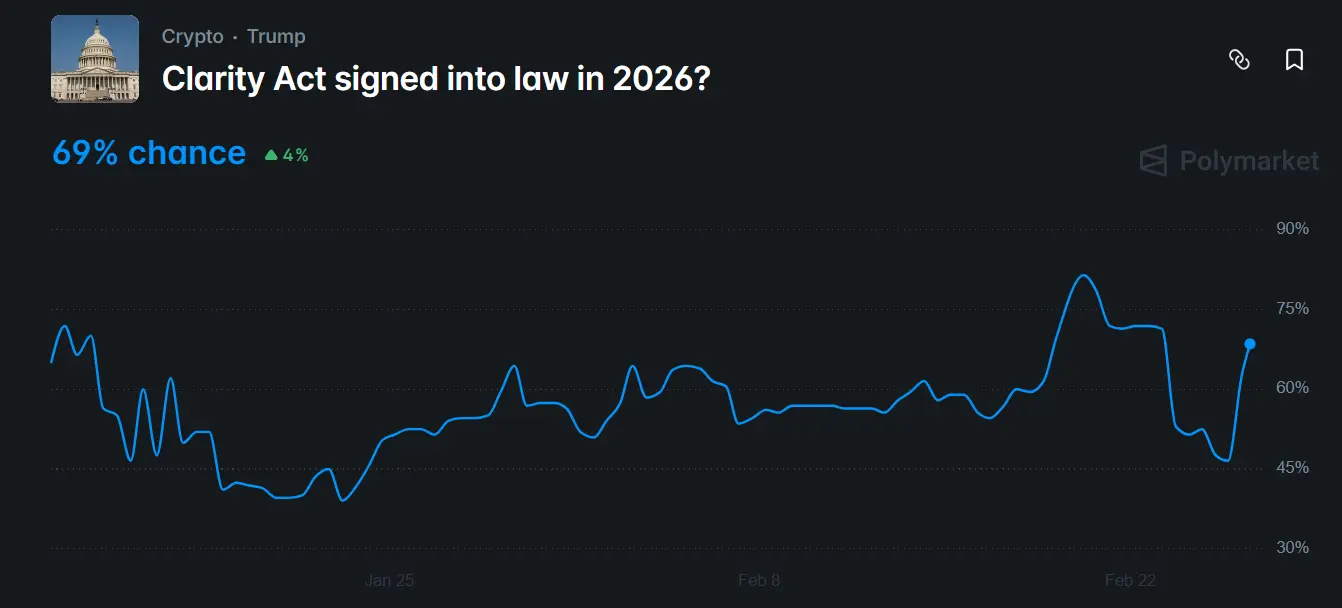 (Source: Polymarket)
Market prediction platforms show that after Trump’s speech on national issues, the probability of the CLARITY Act being signed into law by 2026 dropped to 47%. However, with the progress of Democratic meetings and increased policy lobbying, this probability has rebounded to 69%. This change reflects growing market expectations that U.S. crypto regulation will become clearer, stablecoin policies will be implemented, and the digital asset compliance framework will accelerate formation.
Related Articles
Aave lending and borrowing volume surpasses $1 trillion. Is the AAVE price of $117 undervalued?
Circle stock price surges 35% in a single day, with the surge in USDC circulation and reserve income driving the biggest push
Solana (SOL) price reclaims above the EMA and surges toward $90, with DEX trading volume reaching a new high
Nvidia Commitment on Artificial Intelligence Processors is Reflecting in AI Cryptocurrencies
U.S. Strategic Bitcoin Reserves May Shrink by 30%, Bitfinex Compensation Ruling Pending