# USGovernmentShutdownRisk

30.28K
After the Senate failed to pass a funding bill on Jan 29, the risk of a partial US government shutdown has risen. Do you think a shutdown is likely, and how might it affect the crypto market?
#USGovernmentShutdownRisk
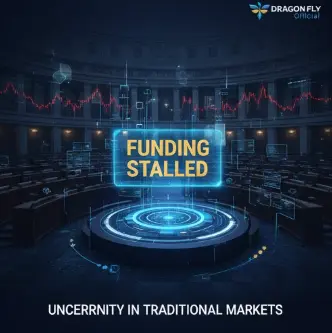
The prospect of a partial US government shutdown has become a key macro risk after the Senate failed to pass the funding bill on January 29, 2026. While a shutdown may be temporary or partial, even short-term interruptions can ripple across financial markets, impacting liquidity, investor confidence, and risk appetite. Discretionary federal spending halts, federal workers may face furloughs, and key operational delays occur in areas like regulatory reporting, economic data releases, and Treasury operations. Historically, these disruptions create uncertainty and volat
BTC-4.64%
ETH-7.06%
USDC0.01%
ALT-4.45%
post-image
post-image
post-image
  • Reward
  • Comment
  • Repost
  • Share
#USGovernmentShutdownRisk Crypto Markets Under Macro Pressure
A U.S. government shutdown occurs when Congress fails to pass—or the President does not sign—funding legislation before existing allocations expire. Under the Antideficiency Act, non-essential federal operations largely cease, resulting in furloughs, delayed public services, and broader economic ripple effects that reach financial markets, including cryptocurrencies.
Historical Context
Before the 1980s, shutdowns were rare and often limited in impact. Since then, they have become more frequent and disruptive, usually driven by parti
BTC-4.64%
ETH-7.06%
XRP-4.15%
  • Reward
  • Comment
  • Repost
  • Share
US Government Shutdown Risk Rises – Crypto Braces for Volatility
The Senate’s failure to pass a funding bill on Jan 29 has raised the possibility of a partial U.S. government shutdown. While shutdowns are not uncommon, even short-term disruptions can create market uncertainty.
Crypto markets respond differently than traditional finance. In times of fiscal uncertainty:
Bitcoin (BTC) often sees inflows as investors seek alternatives to fiat risk.
Volatility spikes are likely, especially in major coins like BTC and ETH.
Liquidity shifts may occur if government paychecks are delayed, slightly affe
BTC-4.64%
ETH-7.06%
post-image
post-image
post-image
post-image
  • Reward
  • 5
  • Repost
  • Share
HighAmbitionvip:
good 👍👍👍
View More
#USGovernmentShutdownRisk
The prospect of a partial US government shutdown has become a key macro risk after the Senate failed to pass the funding bill on January 29, 2026. While a shutdown may be temporary or partial, even short-term interruptions can ripple across financial markets, impacting liquidity, investor confidence, and risk appetite. Discretionary federal spending halts, federal workers may face furloughs, and key operational delays occur in areas like regulatory reporting, economic data releases, and Treasury operations. Historically, these disruptions create uncertainty and volat
BTC-4.64%
ETH-7.06%
USDC0.01%
ALT-4.45%
post-image
post-image
post-image
  • Reward
  • 6
  • Repost
  • Share
ybaservip:
2026 GOGOGO 👊
View More
#USGovernmentShutdownRisk Crypto Markets Under Macro Pressure
A U.S. government shutdown occurs when Congress fails to pass—or the President does not sign—funding legislation before existing allocations expire. Under the Antideficiency Act, non-essential federal operations largely cease, resulting in furloughs, delayed public services, and broader economic ripple effects that reach financial markets, including cryptocurrencies.
Historical Context
Before the 1980s, shutdowns were rare and often limited in impact. Since then, they have become more frequent and disruptive, usually driven by parti
BTC-4.64%
ETH-7.06%
XRP-4.15%
  • Reward
  • 13
  • Repost
  • Share
YingYuevip:
2026 GOGOGO 👊
View More
$BTC at $78,821
Strong rebound from $74,560
Higher lows forming
Buy Zone: $78,000–$78,800
Targets: $79,300 → $81,200
Stop Loss: $77,950
Trend: Short-term bullish
Momentum building
Let’s go 🚀
Trade now $BTC #CryptoMarketWatch #USGovernmentShutdownRisk #CapitalRotation #AltcoinDivergence #WhenWillBTCRebound?
BTC-4.64%
post-image
  • Reward
  • 2
  • Repost
  • Share
repanzalvip:
2026 GOGOGO 👊
View More
#USGovernmentShutdownRisk
⚠️ US Government Shutdown Risk & Crypto Markets
After the Senate failed to pass a funding bill on Jan 29, the risk of a partial government shutdown has increased.
Key Considerations:
• Likelihood: Political gridlock makes short-term shutdown risk real
• Market Impact:
– Crypto volatility may rise as investors seek alternative assets
– Liquidity shifts could occur, affecting BTC, ETH, and altcoins
– Risk sentiment may favor safe-haven assets (gold, stablecoins)
Takeaway:
Monitor macro developments — government funding uncertainty can trigger short-term swings in crypt
BTC-4.64%
ETH-7.06%
post-image
  • Reward
  • 5
  • Repost
  • Share
Discoveryvip:
2026 GOGOGO 👊
View More
#USGovernmentShutdownRisk A U.S. government shutdown occurs when Congress fails to pass—or the President does not sign—funding legislation such as appropriations bills or continuing resolutions before existing funding expires. This creates a funding gap, and under interpretations of the Antideficiency Act shaped by landmark 1980–1981 legal opinions, non-essential federal operations must largely cease. The result is widespread furloughs of federal employees, closure of national parks, delayed public services, and broader economic ripple effects that extend into financial markets.
Historically,
BTC-4.64%
ETH-7.06%
XRP-4.15%
MrFlower_vip
#USGovernmentShutdownRisk A U.S. government shutdown occurs when Congress fails to pass—or the President does not sign—funding legislation such as appropriations bills or continuing resolutions before existing funding expires. This creates a funding gap, and under interpretations of the Antideficiency Act shaped by landmark 1980–1981 legal opinions, non-essential federal operations must largely cease. The result is widespread furloughs of federal employees, closure of national parks, delayed public services, and broader economic ripple effects that extend into financial markets.
Historically, shutdowns were rare before the 1980s, as agencies often continued limited operations during funding gaps. Since then, shutdowns have become more frequent and disruptive, largely driven by partisan standoffs over spending levels, policy riders, immigration, healthcare funding, and debt-ceiling negotiations rather than pure budget math.
Major shutdowns over the past decades highlight how political deadlock translates into economic stress. The 1995–1996 period saw two shutdowns, including a 21-day closure caused by budget disputes. In 2013, a 16-day shutdown occurred due to disagreements over Affordable Care Act funding. The 2018–2019 partial shutdown lasted 35 days over border wall funding, impacted approximately 800,000 workers, and cost the economy an estimated $11 billion. More recently, in 2025, a 43-day shutdown—the longest in U.S. history—was linked to healthcare subsidies and spending disputes, furloughing nearly 900,000 workers and generating billions in economic losses.
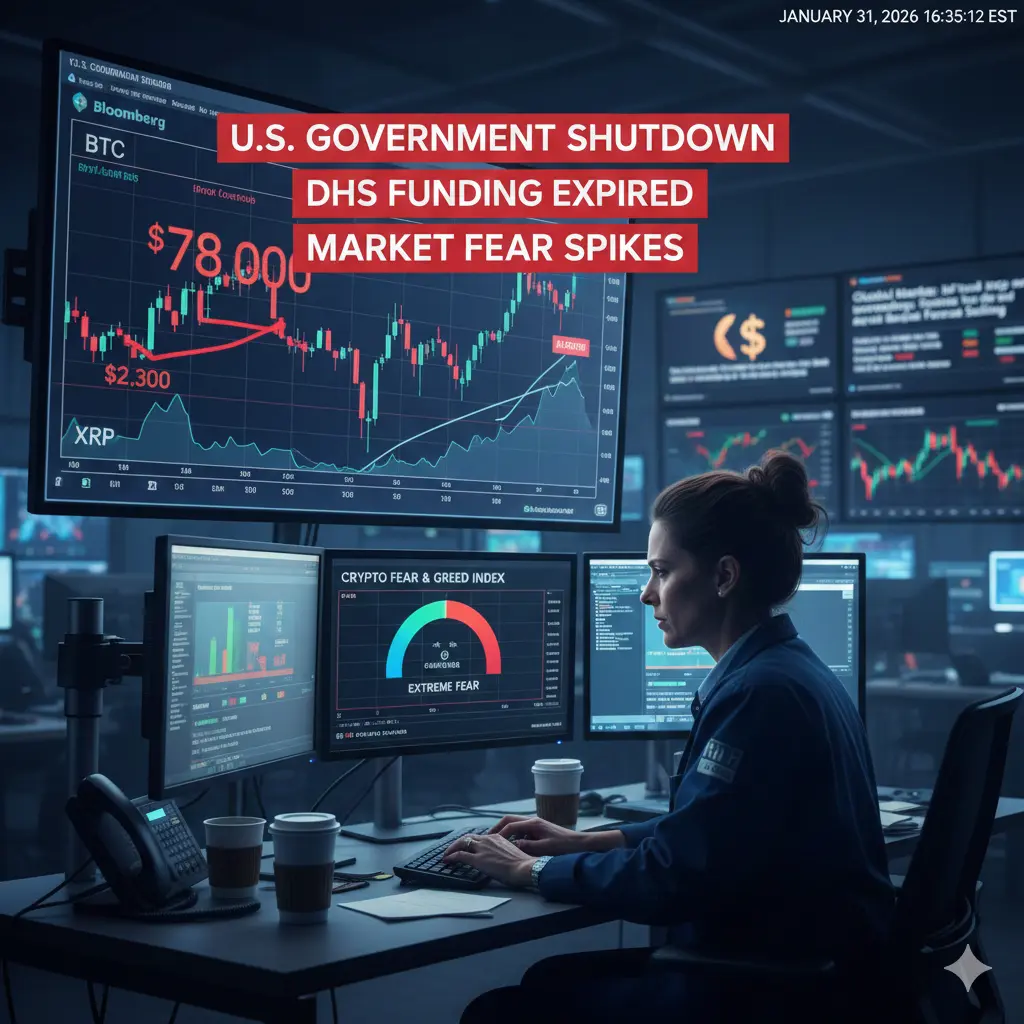
As of January 31, 2026, the U.S. has entered another partial government shutdown following the expiration of funding for several departments, including the Department of Homeland Security. While not all agencies are affected equally, the shutdown has once again injected political and economic uncertainty into global markets, particularly risk assets such as cryptocurrencies.
Crypto markets have responded with clear risk-off behavior. Bitcoin is trading near $78,000, down roughly 7–8% on the week. Ethereum has declined around 9–10% and is hovering close to $2,300. Major altcoins such as XRP are down close to 10%, while mid- and small-cap tokens have suffered drawdowns ranging from 12% to 25%. These moves reflect a classic macro-driven retreat from volatile assets during periods of uncertainty.
Liquidity conditions have tightened noticeably. Shutdown-related uncertainty affects Treasury operations and dollar flows, reducing predictability and weakening market depth across crypto exchanges. Bid-ask spreads have widened, slippage has increased, and executing large trades has become more difficult. This has been compounded by heavy outflows from U.S. spot Bitcoin and Ethereum ETFs, with institutional investors rotating capital toward cash and short-term fixed-income instruments. Reduced liquidity has amplified downside moves, especially during rapid sell-offs.
Despite deteriorating liquidity, trading volume has surged. Bitcoin’s daily volume has jumped toward the $70–$75 billion range, largely driven by forced liquidations, margin calls, and defensive selling rather than organic accumulation. Altcoins, with thinner order books, are experiencing even sharper intraday volatility.
Market sentiment has weakened significantly. The Crypto Fear & Greed Index has fallen into extreme fear territory, derivatives funding rates have turned neutral to negative, leverage is being unwound, and intraday volatility has increased by roughly 20–30% compared to normal conditions. In such an environment, Bitcoin remains vulnerable to additional downside moves, particularly if liquidity continues to drain.
Government shutdowns also delay the release of key U.S. economic data such as employment reports, CPI figures, and payroll data. This creates a data vacuum that increases uncertainty, prompting traders to reduce exposure and further reinforcing low liquidity and choppy, headline-driven price action.
Historically, once shutdown risks are resolved, liquidity tends to return quickly and often triggers relief rallies in risk assets. If a political agreement is reached and the Federal Reserve maintains a supportive stance amid slowing economic momentum, crypto markets could rebound sharply. Until then, critical psychological and technical levels—especially the $75,000–$80,000 range for Bitcoin—remain in focus, with elevated volatility likely to persist.
The bottom line is that a U.S. government shutdown acts as a stress test for crypto markets, compressing liquidity, spiking volume through panic-driven activity, and driving sharp percentage-based price declines. Even after a resolution, volatility may take time to normalize.
repost-content-media
  • Reward
  • Comment
  • Repost
  • Share
#USGovernmentShutdownRisk
Is a U.S. Government Shutdown Likely, and What’s Happening Politically?
As of early February 2026, the U.S. government has already entered a partial shutdown because Congress failed to pass a full funding package by the deadline after the Senate blocked key bills on January 29. What makes this situation particularly noteworthy is not just the risk itself that part was widely anticipated — but the messy political dynamics driving it. Deep partisan disagreements, particularly over Department of Homeland Security (DHS) funding and immigration reform demands from Senate
BTC-4.64%
ETH-7.06%
  • Reward
  • 12
  • Repost
  • Share
Luna_Starvip:
Happy New Year! 🤑
View More
#USGovernmentShutdownRisk
Implications for Markets and Crypto
After the Senate failed to pass the federal funding bill on January 29, 2026, the risk of a partial U.S. government shutdown has risen significantly. While shutdowns have occurred multiple times in U.S. history, the combination of a highly polarized Congress, fragile economic recovery, elevated inflation expectations, and heightened geopolitical risks makes this period particularly sensitive. A government shutdown occurs when federal appropriations bills or a continuing resolution are not enacted, forcing non-essential government o
  • Reward
  • 6
  • Repost
  • Share
YingYuevip:
Happy New Year! 🤑
View More
Load More

Join 40M users in our growing community

⚡️ Join 40M users in the crypto craze discussion
💬 Engage with your favorite top creators
👍 See what interests you
Trade Crypto Anywhere Anytime
qrCode
Scan to download Gate App
Community
English
  • 简体中文
  • English
  • Tiếng Việt
  • 繁體中文
  • Español
  • Русский
  • Français (Afrique)
  • Português (Portugal)
  • Bahasa Indonesia
  • 日本語
  • بالعربية
  • Українська
  • Português (Brasil)