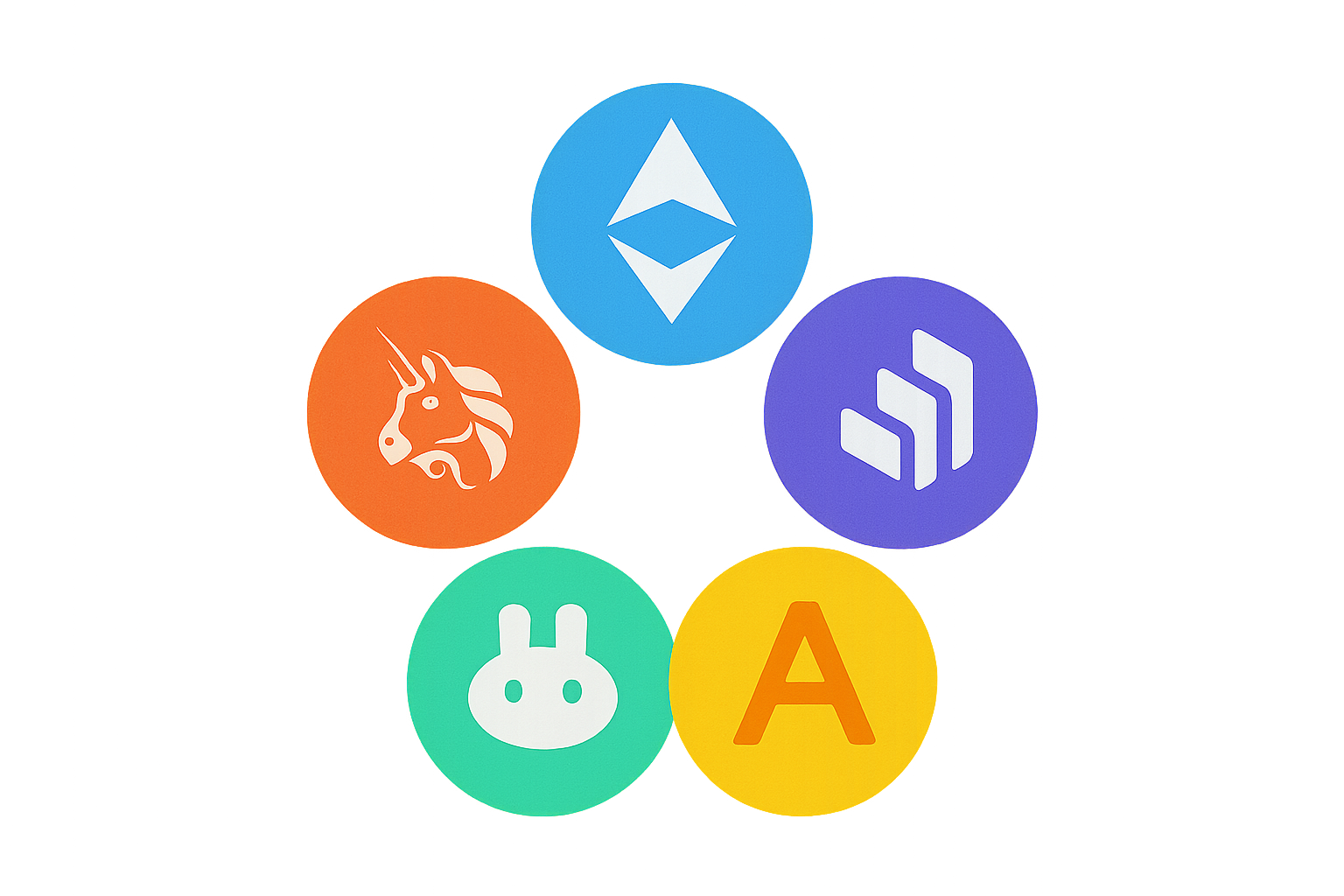
2024 Comprehensive DeFi Token Investment Guide: Detailed Analysis of ETH, Uniswap, PancakeSwap, Compound, Aave, and More. Gain a clear understanding of DeFi investment principles, yield structures, and risk assessment methodologies. Master secure DeFi token investment on Gate and achieve up to 12% APY. A must-read for beginners evaluating DeFi token selection and growth potential.
What Is DeFi Investing?
DeFi, or Decentralized Finance, is a pioneering financial system that enables transactions without relying on traditional intermediaries or governing bodies. This system is built on blockchain technology—specifically distributed ledgers—with the Ethereum blockchain serving as its primary foundation. By utilizing smart contracts, which are self-executing programs, DeFi delivers financial services that allow users to retain full control over their assets at all times.
DeFi offers several distinct advantages over conventional financial systems: unmatched transparency, resistance to censorship, user anonymity, 24/7 availability, and exceptional composability. These features give DeFi tremendous potential in financial technology, attracting a growing number of investors and developers. Below are DeFi’s three core characteristics:
Decentralized Finance Without Central Authority
Unlike traditional financial systems led by banks or corporations, DeFi has no central administrator. Autonomous programs running on blockchain infrastructure deliver all financial services, granting users unrestricted access to open financial platforms. This decentralized approach ensures fairness and inclusivity, reduces the risk of single points of failure, and enhances overall system resilience and security.
Composability
DeFi protocols are highly composable, allowing different financial services to interconnect and create new applications. For instance, users can borrow assets from cryptocurrency lending platforms, instantly trade those assets on decentralized exchanges, or contribute assets to liquidity pools to earn yields. This “financial Lego” concept extends DeFi’s possibilities and fuels limitless innovation.
Easy Access via Wallet Connection
Accessing DeFi services is simple—users only need a cryptocurrency wallet. Connecting a wallet to the blockchain network instantly unlocks a variety of decentralized financial services. With no cumbersome identity verification or credit checks, DeFi dramatically lowers the barrier to entry, delivering true financial inclusivity. This permissionless model is a key factor distinguishing DeFi from traditional finance.
Top 5 DeFi Tokens Worth Considering
Among the vast array of DeFi projects, the following five tokens are highly regarded for their technological innovation, market performance, and ecosystem development, making them top choices for investors:
- Ethereum (ETH)
- Uniswap (UNI)
- PancakeSwap (CAKE)
- Compound (COMP)
- Aave (AAVE)
DeFi Token Highlight ①: Ethereum (ETH)
Ethereum is the flagship token in the DeFi space, commanding a leading position due to its smart contract capabilities, high liquidity, and expansive growth outlook.
Ethereum’s vital role in DeFi stems from its groundbreaking smart contract functionality. Smart contracts are programs that automatically execute when conditions are met, eliminating the need for intermediaries and providing superior transparency and security compared to traditional finance. ETH also serves as the primary liquidity pair across major DeFi protocols, with nearly all prominent platforms supporting ETH trading pairs.
As DeFi and decentralized applications (DApps) continue to grow, demand for the Ethereum network is expected to rise further. The Ethereum 2.0 upgrade will enhance network scalability and energy efficiency, unlocking new use cases and supporting ETH’s value. For DeFi investors, holding ETH is both foundational for ecosystem participation and a key way to share in the sector’s growth.
DeFi Token Highlight ②: Uniswap (UNI)
Uniswap, launched in 2018, is the world’s largest decentralized exchange (DEX), with its governance token UNI playing a critical role in the DeFi ecosystem. Uniswap’s chief innovation is the Automated Market Maker (AMM) algorithm, which revolutionizes how exchanges operate.
Uniswap’s liquidity pool model replaces traditional order books. Users supply crypto assets to pools, and the AMM algorithm automatically matches trades and sets prices. This innovation reduces trading barriers, boosts market efficiency, and provides stable earnings for liquidity providers.
In 2020, Uniswap introduced UNI, a governance token enabling holders to influence protocol decisions and platform development. Users supplying tokens to liquidity pools earn both trading fees and UNI rewards, creating a strong dual incentive for platform growth.
Uniswap continues to lead with technical advances, such as concentrated liquidity in Uniswap V3 and cross-chain bridging solutions. As the DeFi market expands, UNI’s governance utility will strengthen, with future features like staking already in development—pointing to robust long-term value potential.
DeFi Token Highlight ③: PancakeSwap (CAKE)
PancakeSwap is a decentralized exchange built on a major exchange’s smart chain (BSC), with CAKE as its core token. BSC is a high-performance public blockchain compatible with the Ethereum Virtual Machine (EVM), offering faster transactions and lower fees.
Leveraging BSC’s strengths, PancakeSwap achieves much lower trading costs than Ethereum-based DEXs—sometimes only a fraction. This advantage makes PancakeSwap especially popular among retail investors for frequent, small trades. Its user-friendly interface and diverse features have attracted a substantial user base.
CAKE is multifunctional within PancakeSwap’s ecosystem. A portion of each transaction fee is paid to liquidity providers in CAKE tokens. Users can also earn CAKE by depositing crypto assets into liquidity pools, generating passive income. Additionally, CAKE holders exercise governance rights, voting on major platform decisions and shaping PancakeSwap’s future.
For active participants in the BSC ecosystem, CAKE is essential. As BSC and PancakeSwap continue to evolve, CAKE’s utility and value are set to increase.
DeFi Token Highlight ④: Compound (COMP)
Compound is a DeFi lending protocol launched in 2018, with its governance token COMP debuting in 2020. As an early leader in DeFi lending, Compound has set important technical and operational standards for the industry.
Compound allows users to deposit crypto assets to earn interest, with dynamic rates that adjust in real time based on token type and market conditions. Users can also use their deposits as collateral to borrow other cryptocurrencies, enabling flexible asset management and leveraged strategies.
Compound’s longevity has earned it a strong reputation for security and reliability. Despite the sector’s inherent risks, Compound maintains stable operations through rigorous code audits, bug bounty programs, and ongoing security upgrades, securing trust from the DeFi community.
COMP provides governance rights, letting holders propose protocol changes and vote on key decisions. As the DeFi lending market grows, Compound’s market position and COMP’s value offer considerable long-term potential, making COMP a top DeFi asset to watch.
DeFi Token Highlight ⑤: Aave (AAVE)
Aave is one of the largest platforms in the DeFi space, offering lending, liquidity mining, staking, and more. Its AAVE token plays a central role in platform governance and risk management.
AAVE gives holders governance authority over platform operations, enabling them to propose and vote on protocol upgrades, new asset launches, and risk parameter adjustments. This decentralized governance ensures Aave can evolve with community needs and remain competitive.
Beyond governance, AAVE serves as a safety module—staked AAVE can cover losses in case of protocol issues, protecting user assets. This risk-buffering mechanism adds real economic value to the token and strengthens platform resilience.
Aave is recognized for innovation, introducing flash loans, credit delegation, and adjustable interest rates. As a leading DeFi platform, Aave boasts a large user base and deep liquidity. Continued ecosystem growth is expected to drive demand and value for AAVE upward.
How to Identify the Best DeFi Tokens for Investment
Effective selection of top DeFi investments requires rigorous analysis and a scientific approach. Two practical criteria can help investors pinpoint high-potential DeFi tokens:
- Ranked in the Top 30 on DeFiLlama
- Tokens You’ve Personally Used
Identification Method ①: Top 30 Ranking on DeFiLlama
Protocols ranked in the top 30 on DeFiLlama are generally considered safer investment options. DeFiLlama is a leading data platform that tracks and displays DeFi protocols’ Total Value Locked (TVL)—the total assets secured in each protocol, indicating scale, popularity, and market position.
DeFiLlama covers protocols across major blockchains such as Ethereum, BSC, and Polygon, providing users with transparent data on TVL, user count, trading volume, and more. This information supports objective investment decisions and helps identify valuable projects.
Top 30 protocols typically feature high TVL (demonstrating substantial market trust), large user bases (indicating strong product-market fit), and proven market longevity (suggesting robust security). These factors reduce the risks of hacks and major vulnerabilities, making them relatively safe investment choices in DeFi.
Still, even leading protocols carry risks. Investors should evaluate technical features, team background, and community engagement, and allocate capital according to personal risk tolerance.
Identification Method ②: Tokens You’ve Personally Used
Investing in DeFi platforms and tokens you’ve experienced firsthand is a wise strategy. Personal use offers deeper insights than simply reading whitepapers or news.
Direct platform interaction reveals key information:
Platform Mechanics
Hands-on experience clarifies how funds flow between lenders and borrowers, fee structures, risk points, and smart contract efficiency. This firsthand knowledge enables better assessment of technical strength and product maturity.
User Community and Ecosystem
Usage allows observation of user scale, demographics, community activity, and team responsiveness. A healthy DeFi project features an active and growing user base, which is vital for long-term success.
Investing in tokens without firsthand experience increases vulnerability to hype, speculation, or external opinions, leading to emotional decisions and higher risk. Firsthand experience helps close the gap between marketing and reality.
Investors should test platforms with small amounts before committing larger capital. By verifying usability, security, and utility directly, investors can make more informed and lower-risk decisions. “Try before you buy” may require extra effort but greatly increases investment success rates.
Conclusion: Earning Returns by Investing in DeFi Tokens
This article has provided an in-depth look at five standout DeFi tokens and analyzed their respective features and investment value. As an innovative system for financial transactions without intermediaries or governing bodies, DeFi is reshaping the financial landscape.
DeFi’s key advantages over traditional finance include higher potential yields, 24/7 trading services for real-time strategy adjustments, and decentralized asset control—letting users retain complete authority over their holdings without fear of misuse or asset freezing.
Tokens such as Uniswap (UNI) and PancakeSwap (CAKE) have gained market favor due to mature technology, large user communities, and continuous innovation. These projects show strong current performance and offer significant future growth potential. Ethereum (ETH) is the DeFi ecosystem’s cornerstone, while Compound (COMP) and Aave (AAVE) are leaders in the lending space, all deserving long-term attention.
Nevertheless, all investments carry risk, and DeFi is no exception. Smart contract bugs, market swings, and regulatory changes can affect returns. Before investing, thoroughly research project fundamentals, technical structure, team background, and market position.
Adopt a cautious yet proactive investment strategy: start with small amounts to test DeFi platforms, scale up only after understanding operations, diversify investments, monitor market trends and project updates, and adjust your portfolio as needed.
As blockchain technology matures and the DeFi ecosystem evolves, new opportunities will arise for investors. With diligent research, careful decision-making, and ongoing learning, investors can achieve notable returns in the DeFi market. Let’s embrace this innovative financial era together.
FAQ
What Is DeFi? How Is DeFi Investing Different from Traditional Finance?
DeFi—decentralized finance—operates on blockchain using smart contracts and eliminates reliance on banks. DeFi investing is managed autonomously without central oversight, while traditional finance depends on banks and regulatory authorities.
What Are the Main Risks in DeFi Token Investing? How Can You Assess Them?
Key risks include smart contract vulnerabilities, market volatility, governance risks, and blockchain infrastructure issues. Assess risks by conducting thorough due diligence, reviewing code audits, using stop-loss orders, investing only what you can afford to lose, and diversifying your portfolio.
What Indicators Should You Consider When Selecting DeFi Tokens? (Liquidity, Locked Value, Team Background, etc.)
Focus on total value locked (TVL), market capitalization, team reputation, trading volume, inflation rate, and real token utility. These metrics help evaluate project health and long-term prospects.
What Are the Leading DeFi Tokens? What Are Their Key Features and Use Cases?
Major DeFi tokens include Uniswap (UNI), Aave (AAVE), and Curve (CRV). UNI supports governance for decentralized exchanges, AAVE powers lending and staking, and CRV facilitates stablecoin swaps. Each underpins core DeFi activities like trading, lending, and liquidity mining.
Where Do DeFi Investment Returns Come From? How Do You Earn from Staking, Liquidity Mining, and Lending?
DeFi returns stem from three main channels: staking (locking crypto assets for daily rewards), liquidity mining (providing token pairs for trading fees and rewards), and lending (earning interest by lending assets). Annual yields often reach 6%–12%, well above traditional banking rates.
How Can You Participate in DeFi Investing Safely? What Security Issues Should You Watch For?
Conduct comprehensive research on project fundamentals, use secure wallets and protect private keys, diversify investments to reduce risk, beware of high-yield promises, check smart contract audit reports, stay informed on security best practices, and carefully weigh risks and rewards.
What Is the Outlook for DeFi Tokens? Which Projects Are Worth Watching in 2024?
DeFi’s outlook is bright, with ongoing innovation. In 2024, notable projects include Helium (IoT), Filecoin (decentralized storage), Arweave (permanent storage), Theta Network (video streaming), and IOTA (distributed ledger). These projects are transforming finance, with rising transaction volumes and strong growth potential.
* The information is not intended to be and does not constitute financial advice or any other recommendation of any sort offered or endorsed by Gate.